Paying $1,200 or $2,600 for an everyday e-bike, and where the difference actually shows up
- Subject
- Choosing, paying for and maintaining an everyday electric bicycle, with attention to low step-over frames
- Editor
- The Fell Shadow team
- Subject
- Choosing, paying for and maintaining an everyday electric bicycle, with attention to low step-over frames
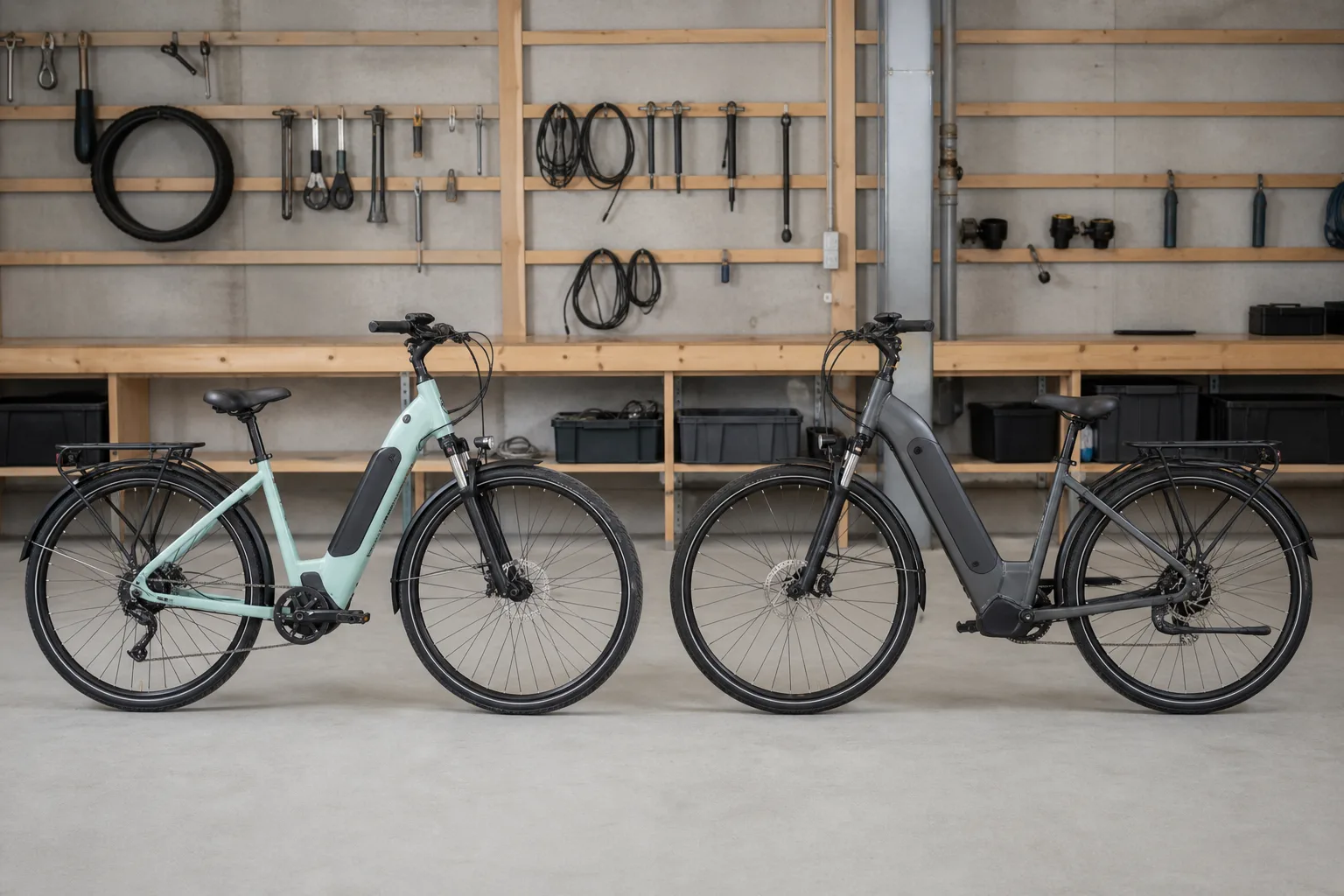
An electric bicycle is a bicycle with roughly four expensive things bolted to it: a battery pack, a motor, a controller, and a display. Everything else is a bicycle, and bicycles have had legible pricing for a century. That is useful, because it means you can take almost any quoted price apart and see where it went. A bike at the low end and a bike at twice the money often share a frame shape, a wheel size and a general silhouette, and the difference between them lives in perhaps six components you can name. Knowing which six is most of the decision.
The battery is the single biggest line item
A pack is a case, a set of cylindrical lithium-ion cells, a battery management system that watches voltage and temperature, and a mount. The cells are the money. Packs built on cells from the large, named manufacturers cost more per watt-hour than packs built on unbranded cells, and the difference shows up not on day one but at year three, as capacity fade: the range you get on a full charge quietly shrinking. Watt-hours, which is volts multiplied by amp-hours, is the number worth comparing, because it describes stored energy rather than marketing. The Consumer Product Safety Commission oversees the safety of consumer products including e-bike batteries and chargers, and certification to a recognized safety standard is the one line on a spec sheet you should not treat as optional.
The second thing the battery price buys is serviceability. A pack in a common, widely used case, mounted so a shop can slide it out without dismantling the frame, can be replaced or rebuilt years later. A pack integrated into a proprietary downtube, with a connector nobody else uses, cannot be, or not cheaply. That is a real cost, deferred rather than avoided, and it belongs in your arithmetic when you compare two bikes that look similar on paper.
Motor numbers that matter and motor numbers that do not
Most everyday bikes use a geared hub motor in the rear wheel. It is quiet enough, cheap to build, and it drives the wheel directly, so it does not wear your chain and cassette any faster than your legs would. Nominal wattage, the number printed largest in the listing, tells you less than people assume, because manufacturers rate the same hardware differently and peak output can be double the nominal figure. Torque in newton-meters is the more honest number for hills and for starting from a stop with groceries aboard. So is the sensor: a cadence sensor switches power on when the cranks turn, while a torque sensor meters power against how hard you are pushing, and the second one is a large part of why a mid-priced bike feels like a bicycle rather than a scooter.
Brakes, wheels and the parts that carry the weight
An electric bike is heavy, often in the sixty to seventy pound range with rack and battery, and it arrives at intersections faster than an unassisted bike. That changes what brakes have to do. Mechanical disc brakes, pulled by a cable, work and are easy to adjust anywhere; hydraulic discs need less hand force, hold their adjustment longer as the pads wear, and are noticeably better on a wet descent with a loaded rack. Rotor size matters as much as the caliper. The wheels carry the rest of the argument: a hub motor puts an unusual load on the spokes on one side, so spoke gauge, tension and a rim with eyelets are what stand between you and a wheel that needs truing every few months. This is unglamorous money, and it is well spent.
What a low frame costs to build properly
Dropping the top tube so you can step through rather than swing a leg over removes the structural member that resists twisting, and a good frame puts that stiffness back with a deeper, larger-diameter downtube, a reinforced junction at the head tube, and sometimes a second tube running low along the frame. Do it cheaply and the bike develops a mild wobble at speed, or a vague feeling under braking, that no adjustment will cure. Do it properly and you get a bike that handles like any other. That is one reason a well-built step through ebike tends not to be the cheapest thing in the catalog. The fittings follow the same logic: a rack rated for real weight and bolted to the frame rather than the seatpost, full fenders with a stay that does not rattle loose, a kickstand that holds a loaded bike, lights wired to the main battery rather than run on their own coin cells.
Where the extra thousand dollars shows up
In daily use, the jump from a budget bike to a mid-priced one is felt in four places, and range is not the first of them. It is the torque sensor smoothing the first fifty feet from a stop sign. It is brakes that still bite in February. It is a wheel that stays true and a headset that does not develop play after one salty winter. And it is the part you cannot see from the saddle: a bike built from parts a local shop stocks, on standards it recognizes, so the repair three years from now is a Tuesday afternoon rather than a search for a discontinued proprietary part.
Price the two bikes over five years instead of one. Add a replacement pack, a set of pads, a chain or two, and one wheel rebuild to each, and the gap between them narrows considerably, sometimes to nothing. The cheaper bike is a genuinely good decision when the errands are short, flat and dry. When they are not, the money moves to the parts that are doing the work.
- 01
Cell provenance
Packs built on cells from large, named manufacturers hold capacity better over several years than packs built on unbranded cells. The difference rarely shows in the first season.
- 02
Certified charger and pack
Certification to a recognized safety standard covers the pack, the battery management system and the charger together. Treat it as a requirement rather than a feature.
- 03
Removable pack design
A battery that slides out of a mount can be charged indoors and replaced later by any competent shop. A pack sealed into the frame limits both.
Torque versus wattage
Nominal wattage is rated inconsistently across brands and tells you little about hill performance. Torque in newton-meters is the figure that predicts how the bike starts on a grade.
Cadence and torque sensing
A cadence sensor turns assistance on when the pedals move, producing a slight surge at every start. A torque sensor scales power to your effort and is the main reason mid-priced bikes feel more natural.
Hydraulic brake advantage
Hydraulic discs need less hand force and self-adjust as pads wear, which matters on a sixty-pound bike in wet weather. Mechanical discs are simpler to service on the road.
Rotor diameter
A larger rotor gives the caliper more leverage and sheds heat better on long descents. It is a cheap upgrade that does more than a fancier caliper on the same small rotor.
Spokes around a hub motor
A hub motor loads spokes unevenly and stresses the wheel more than a standard hub. Heavier spokes, proper tension and an eyeleted rim keep the wheel from needing repeated truing.
Frame stiffness without a top tube
Removing the top tube takes away torsional stiffness that has to be replaced somewhere. A deeper downtube and a reinforced head tube junction are what keep a low frame from feeling vague under braking.
A component-by-component look at what your money buys in an everyday electric bike, and which parts of the spec sheet change how it rides on real errands.
Watt-hours over amp-hours